
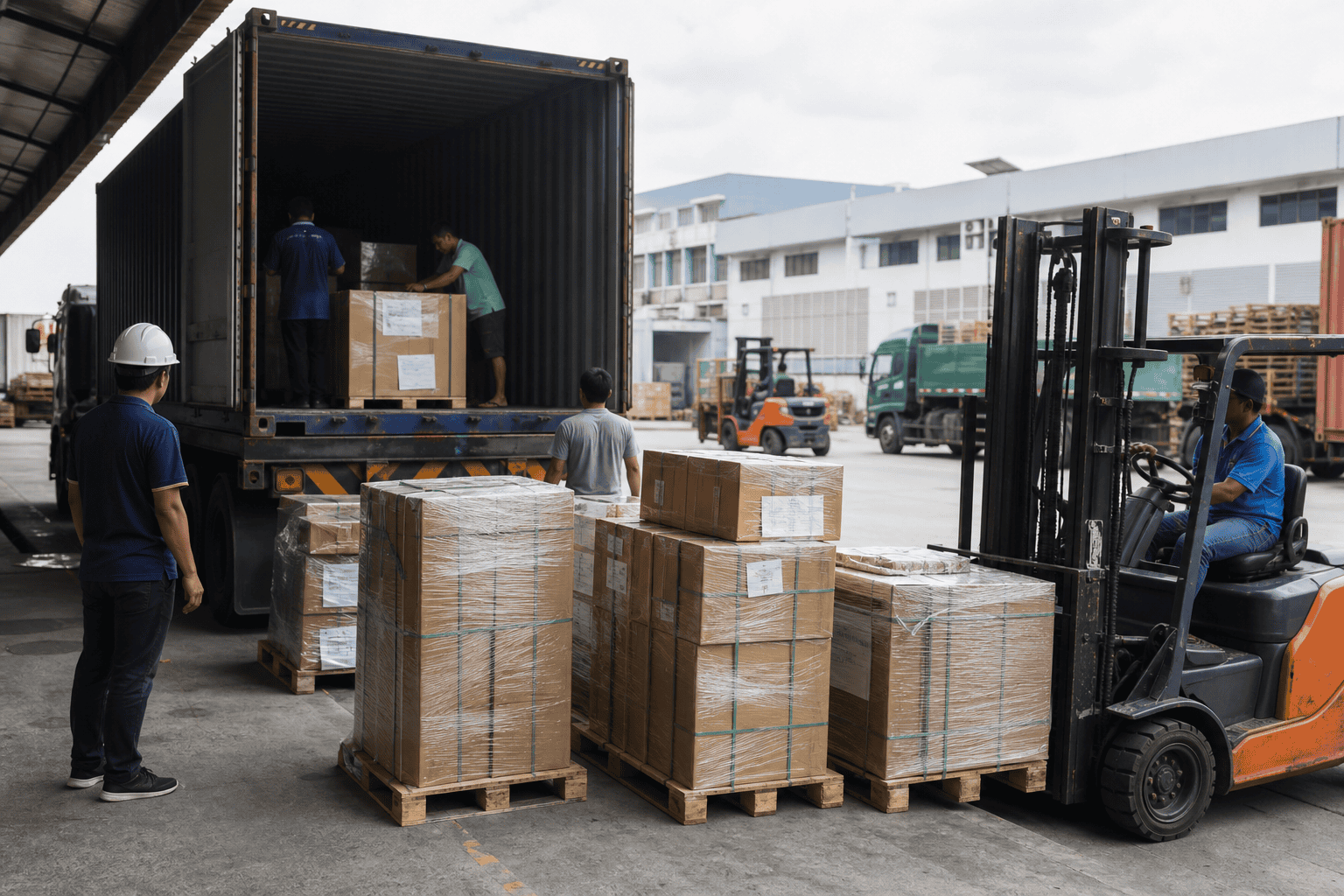
LCL, or less-than-container-load shipping, lets an exporter use part of a shared ocean container. It is worth comparing when your shipment does not justify a dedicated container and can accommodate consolidation and destination release. The decision should use a full delivered quotation, measured packed cargo and the buyer’s deadline.
Understand the LCL journey
Your goods move to an origin container freight station, are consolidated with compatible shipments, travel by sea and are separated at a destination freight station. Export and import clearance, pickup and final delivery depend on the agreed service scope. More handling steps make suitable packaging and clear marks especially important.
Ask whether the consolidation is direct to the destination station or passes through another hub. Port-to-port vessel time excludes warehouse receipt, consolidation, transshipment, deconsolidation, clearance and delivery. Plan customer commitments against the complete timeline, including the cargo cut-off.
Calculate cubic meters without mixing units
Dimensions in meters: CBM = length × width × height. Do not divide this result by 1,000,000.
Dimensions in centimeters: CBM = length × width × height ÷ 1,000,000. Measure the outer packed dimensions, including a pallet, crate and any overhang. Sum the volumes of all packages; do not measure only the goods inside.
Illustrative example: one pallet measuring 1.2 × 1.0 × 1.5 meters occupies 1.8 CBM. The equivalent calculation is 120 × 100 × 150 cm ÷ 1,000,000 = 1.8 CBM. Three identical pallets total 5.4 CBM. Gross weight must be declared separately. For irregular cargo, ask how the station measures the occupied envelope.
Ask how each charge is calculated
LCL quotations can use weight/measurement, minimum charges and per-shipment fees. A commonly encountered weight/measurement comparison is one cubic meter versus one metric ton (1,000 kg), taking the larger chargeable quantity, but the applicable tariff and individual fees must be confirmed. Airfreight volumetric divisors do not apply automatically to sea LCL.
Weight/measurement example: if the tariff compares cubic meters with metric tons, the three pallets above occupy 5.4 CBM. At 2,400 kg gross, the comparison is 5.4 CBM against 2.4 metric tons, so 5.4 is the larger quantity. That does not make every fee chargeable on 5.4 units: documentation, minimums and destination fees may use a different basis.
| Cost group | Questions to ask |
|---|---|
| Origin | Pickup, customs, receiving, handling and documentation included? |
| Ocean | Rate basis, minimum, surcharges and validity? |
| Destination | Station handling, agent release, brokerage and delivery included? |
| Exceptions | Storage, inspections, remeasurement, taxes and insurance excluded? |
Compare the same Incoterm, addresses, currency and delivery scope. Destination charges can materially change the result for a small shipment. Request written inclusions and identify which party pays each locally collected fee.
Compare LCL with FCL and air
There is no universal CBM threshold at which FCL becomes cheaper. Obtain an FCL quote for the same route when volume increases, when cargo is fragile or when additional LCL handling is undesirable. Compare total cost, cargo compatibility, container utilization and receiving arrangements rather than ocean freight alone.
Air may suit a small urgent order even if its transport rate is higher. LCL may suit planned replenishment where the longer overall cycle is acceptable. For repeat orders, consolidate production batches only when the inventory saving and deadline still justify waiting. Do not reduce packaging merely to cross a price threshold.
Prepare cargo for shared-container handling
- Use packaging suitable for lifting, stacking and the complete journey.
- Declare stackability; identify fragile, moisture-sensitive and high-value cargo.
- Mark each package consistently with the packing list and consignee information.
- Supply gross weight and packed dimensions for every package.
- Disclose dangerous goods, batteries, liquids and wood packaging early.
- Photograph the packed goods and keep a condition record before handover.
The IMO/ILO/UNECE CTU Code provides packing and securing guidance. It does not replace product-specific rules or professional assessment of your packing. Confirm receiving criteria with the consolidation station before dispatching cargo.
Book with a clear release plan
Confirm the origin station, delivery cut-off, document deadline, planned routing and destination agent. Ensure the importer or broker is ready before arrival. Ask for the release procedure and free-storage terms in writing, including when storage charges start and whether weekends count.
Carrier or forwarder liability is not the same as cargo insurance. Ask what insurance has actually been arranged and what risks, excesses and exclusions apply. Track warehouse receipt, departure, arrival, release and final delivery separately. Everbest can discuss available sea-freight options and compare LCL with alternatives using your shipment details.
Request a complete LCL quotation
Send Everbest your pickup and delivery addresses, cargo description, package dimensions and weight, ready date and required delivery date. Include the pallet or carton count, packed dimensions, gross weight and whether the cargo can be stacked. Ask for an itemized LCL quote naming the origin and destination stations, weight/measurement basis, minimum charges, locally collected fees and quote validity. Contact Everbest.
Further reading
- Sea Freight vs Air Freight: Complete Comparison Guide
- How Air Cargo Consolidation Can Save Costs for Vietnamese Exporters
- A Step-by-Step Guide to Navigating Vietnam’s Customs Clearance Process